
Businesses today use chatbots for everything from answering customer questions to collecting leads, booking appointments, and providing support. Landbot is a no-code chatbot and AI agent platform designed to help businesses create these conversational experiences without needing to write code.
The platform combines visual rule-based chatbot flows with AI agents, allowing businesses to decide which parts of a conversation should follow fixed paths and which can be handled more flexibly by AI. Landbot supports website conversations, WhatsApp, Facebook Messenger, and APIchat.
But is Landbot worth using for your business? Let’s look at its features, AI capabilities, integrations, channels, pricing, and overall experience.
About Landbot

Landbot is a no-code platform for creating chatbots and AI agents through a visual builder. Instead of building a chatbot entirely through code, users can create conversation flows using blocks and connect different steps visually.
The platform can be used for lead generation, customer support, appointment booking, sales qualification, FAQs, data collection, and other conversational workflows.
One of Landbot’s main features is its ability to combine traditional rule-based flows with AI. A business can use fixed buttons and predefined paths where complete control is needed while allowing an AI agent to handle open-ended questions elsewhere in the conversation.
What Does Landbot Offer?
Landbot provides several tools designed around conversational marketing, sales, support, and automation.
No-Code Chatbot Builder
The visual builder is at the center of the platform.
Users can create conversations by arranging blocks that represent messages, questions, buttons, conditions, data fields, and other actions. This makes it possible to build structured customer journeys without developing the entire chatbot from scratch.
Templates can also help users start with common use cases instead of building every flow from an empty canvas.
The visual approach can be especially useful for marketing and sales teams that want to make changes themselves without depending on developers.
AI Agents
Landbot’s AI agents are designed to handle conversations using natural-language responses and information provided by the business.
The company says AI agents can work with a business’s own knowledge base, allowing responses to be grounded in the information supplied by the organization. Businesses can also combine AI with predefined flows so that important steps remain controlled while AI handles more flexible questions.
This hybrid approach can be useful when a company wants the flexibility of AI without giving up control over important parts of the customer journey.
AI agents can be used for answering questions, qualifying leads, guiding customers, and routing conversations toward the appropriate next step.
Website Chatbots
Landbot can be deployed directly on websites.
Businesses can use the chatbot as a chat widget, popup, embedded conversation, or full-page conversational experience. This gives companies different ways to integrate a chatbot into their website depending on the type of customer journey they want to create.
For example, a company could use a website chatbot to ask visitors what they need, collect contact information, qualify potential customers, and then send the information to a sales team.
This can make the chatbot more than a simple customer-support window.
WhatsApp Automation
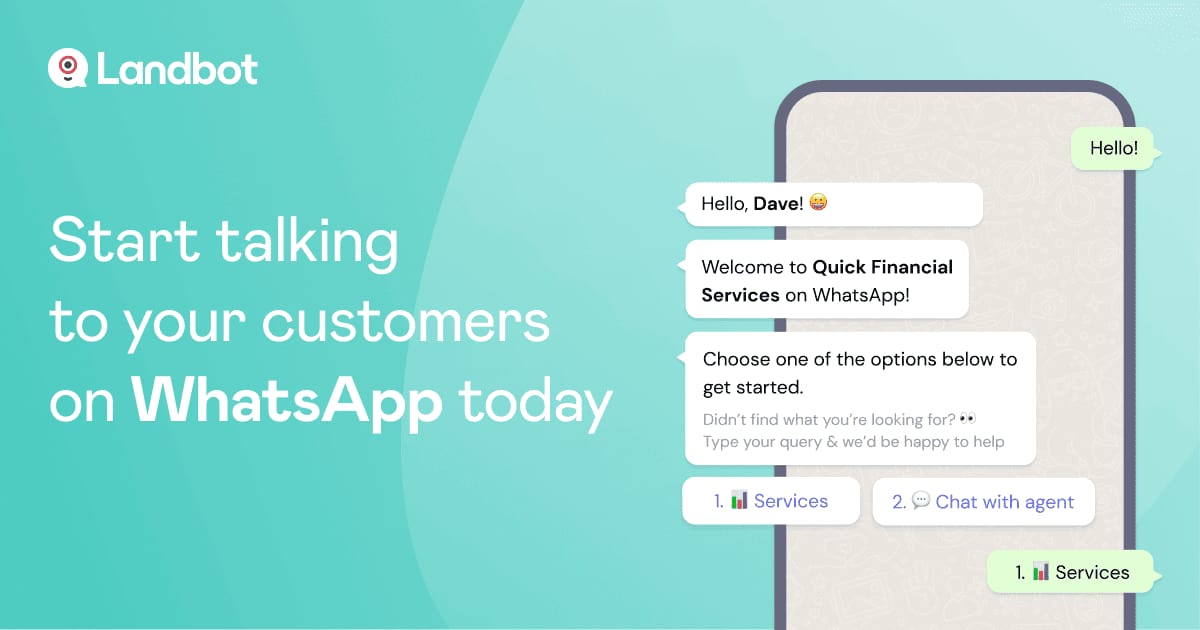
Landbot also supports WhatsApp Business conversations.
Businesses can create automated WhatsApp flows for lead generation, customer support, appointment booking, follow-ups, and other use cases. Quick reply buttons and keyword-based options can help customers navigate conversations without typing everything manually.
Human takeover is also available, allowing a conversation to move from automation to a human agent when necessary.
This can be useful when a customer starts with an automated conversation but eventually needs personalized assistance.
Lead Generation and Qualification
Lead generation is one of the major use cases for Landbot.
Instead of displaying a traditional contact form, businesses can use conversational questions to collect information from visitors. The chatbot can ask questions one at a time, capture answers, and use the collected information to determine what happens next.
AI agents can also help qualify leads based on criteria defined by the business. Landbot promotes AI-powered sales experiences that can answer questions, gather information, and pass qualified prospects to sales teams.
This approach can make lead forms feel more interactive while giving sales teams structured information about potential customers.
Integrations
Landbot can connect with external tools to move collected information into other business systems.
The platform supports integrations with services such as HubSpot, Salesforce, Pipedrive, Zoho, Google Sheets, and other applications depending on the selected plan.
Webhooks and API capabilities are also available on higher plans, giving businesses more flexibility when connecting Landbot with their existing technology stack.
These integrations can be useful when a chatbot needs to do more than collect information and instead trigger actions elsewhere.
For example, a qualified lead can be sent to a CRM, while form responses can be stored in a spreadsheet or another connected system.
Human Handoff
Automation does not have to mean removing people from the conversation.
Landbot supports human takeover, allowing conversations to be transferred to a human agent when a situation requires personal assistance. The platform says the conversation context can be passed along so the customer does not have to repeat everything.
This can create a hybrid support system where simple questions are handled automatically while more complicated requests reach a member of the team.
Forms, Data Collection and Automation
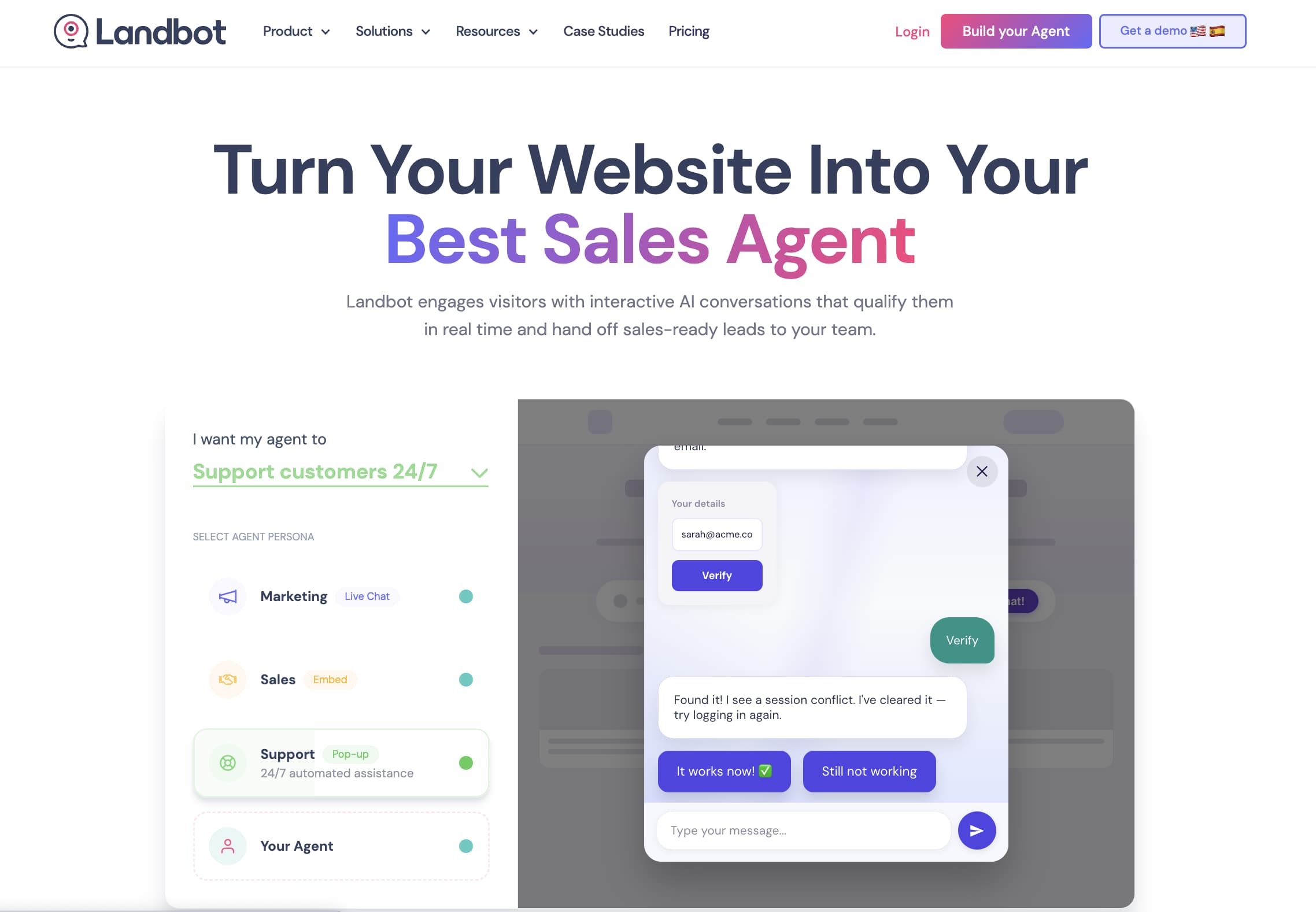
Landbot can also be used to collect structured information through conversational forms.
Businesses can ask customers for details such as names, contact information, preferences, requirements, or booking information. Responses can be stored in fields and passed to connected tools or workflows.
This can be useful for applications such as appointment requests, customer onboarding, surveys, lead qualification, and support intake.
Because the information is collected as part of the conversation, businesses can create more guided experiences than a simple static form.
Landbot Pricing
Landbot currently offers a free plan along with paid plans designed for different levels of usage.
The current pricing page lists the Free plan at €0, with 100 chats per month and one seat. The Starter plan is listed at €40 per month, while annual billing currently shows an effective price of €32 per month. It includes 500 chats per month and 100 AI chats.
The Professional plan is listed at €100 per month, or €80 per month when billed annually, with 2,500 chats per month and 300 AI chats. It also adds features such as premium integrations, webhooks, API access, live chat support, and removal of Landbot branding.
Business pricing is custom and starts from €400 per month according to Landbot’s current pricing information. WhatsApp-related plans and additional WhatsApp usage have separate pricing considerations.
Landbot also states that paid plans include additional charges when usage exceeds included chat allowances, while AI chats have their own included allowances and overage pricing.
Since plans and pricing can change, businesses should check the current plan details before subscribing.
Pros and Cons of Landbot
Pros
- No-code visual chatbot builder
- AI agents and rule-based chatbot flows
- Website and WhatsApp deployment
- Facebook Messenger and APIchat support
- Lead generation and qualification tools
- Human handoff capabilities
- CRM and business-tool integrations
- Webhooks and API support on higher plans
- Templates for faster chatbot creation
- Free plan available
- Suitable for sales, support, bookings, and data collection
- AI can be combined with controlled conversation flows
Cons
- Advanced integrations require higher plans
- AI chat usage has separate limits
- Monthly chat allowances vary by plan
- WhatsApp usage can add additional costs
- Higher-volume businesses may need custom pricing
- The visual builder can require time to configure complex workflows
- Some advanced features are unavailable on the free plan
- Businesses need to plan chatbot flows carefully for more complicated use cases
Who Is Landbot Best For?
Landbot can be useful for businesses that want to create conversational experiences without building a chatbot entirely from code.
Marketing teams can use it for lead generation, sales teams can use it for qualification, customer-service teams can automate common questions, and businesses can use it for appointment or booking workflows.
It can also suit companies that want to combine AI responses with structured conversation flows. This gives teams the ability to let AI handle natural-language questions while keeping important business processes under predefined rules.
Businesses already using CRM platforms such as HubSpot or Salesforce may also benefit from Landbot’s integrations, depending on their plan.
Is Landbot Worth It?
Landbot offers a combination of visual chatbot building, AI agents, automation, integrations, and human support handoff.
Its biggest advantage is the ability to combine AI with rule-based flows. Businesses do not have to choose between a completely scripted chatbot and a fully open-ended AI system. They can use predefined steps where control matters and AI where natural conversations are more useful.
The main consideration is pricing and usage. Smaller businesses can start with the free plan, but businesses needing higher chat volumes, advanced integrations, WhatsApp, or more AI usage may need a paid subscription.
For businesses that want to build conversational sales, support, or lead-generation experiences without relying heavily on coding, Landbot is worth considering.
Final Verdict
Landbot is a flexible no-code platform that combines traditional chatbot workflows with AI-powered conversations.
Its visual builder, website chatbot tools, WhatsApp automation, AI agents, integrations, lead qualification features, and human handoff options make it suitable for a range of business workflows. The platform also provides a free plan, allowing businesses to explore the basic experience before moving to paid features.
The main factors to consider are expected chat volume, required integrations, AI usage, WhatsApp requirements, and the level of customization your business needs.
If you want a no-code platform for creating structured and AI-assisted customer conversations across web and messaging channels, Landbot is worth considering.