
Learning a new language can be challenging when lessons rely heavily on translation, memorization, or repetitive exercises. Rosetta Stone takes a different approach by placing learners directly into the language they are studying and using images, audio, context, and interactive activities to build understanding.
The platform has been offering language-learning software for decades and now combines its established Dynamic Immersion method with newer tools under Rosetta Stone Sapphire. The current platform includes immersive lessons, pronunciation practice, conversation activities, flashcards, personalized learning tools, and access to 25 languages.
About Rosetta Stone
Rosetta Stone is a language-learning platform designed for people who want to develop reading, writing, speaking, and listening skills through structured lessons.
Its central approach is Dynamic Immersion. Instead of constantly translating new words into a learner’s native language, lessons use images, written words, spoken language, and context to help learners understand meaning directly. Rosetta Stone says the method is designed to encourage learners to think in their new language rather than depend on translation.
The platform is available for individual learners as well as schools and businesses, making it suitable for different types of language-learning goals.
Rosetta Stone Dynamic Immersion
Dynamic Immersion is the foundation of the Rosetta Stone learning experience.
Lessons are presented primarily in the target language, with visual and contextual clues helping learners understand new words and phrases. For example, a learner may see an image alongside a word or phrase and use the surrounding context to determine its meaning.
The approach gradually moves from individual words to phrases, sentences, and conversations. Rosetta Stone also uses audio from native speakers so learners can become familiar with pronunciation and natural speech patterns.
This makes the learning experience different from traditional courses that explain every new word through direct translation.
Rosetta Stone Learning Path
The Learning Path provides a structured route through the course.
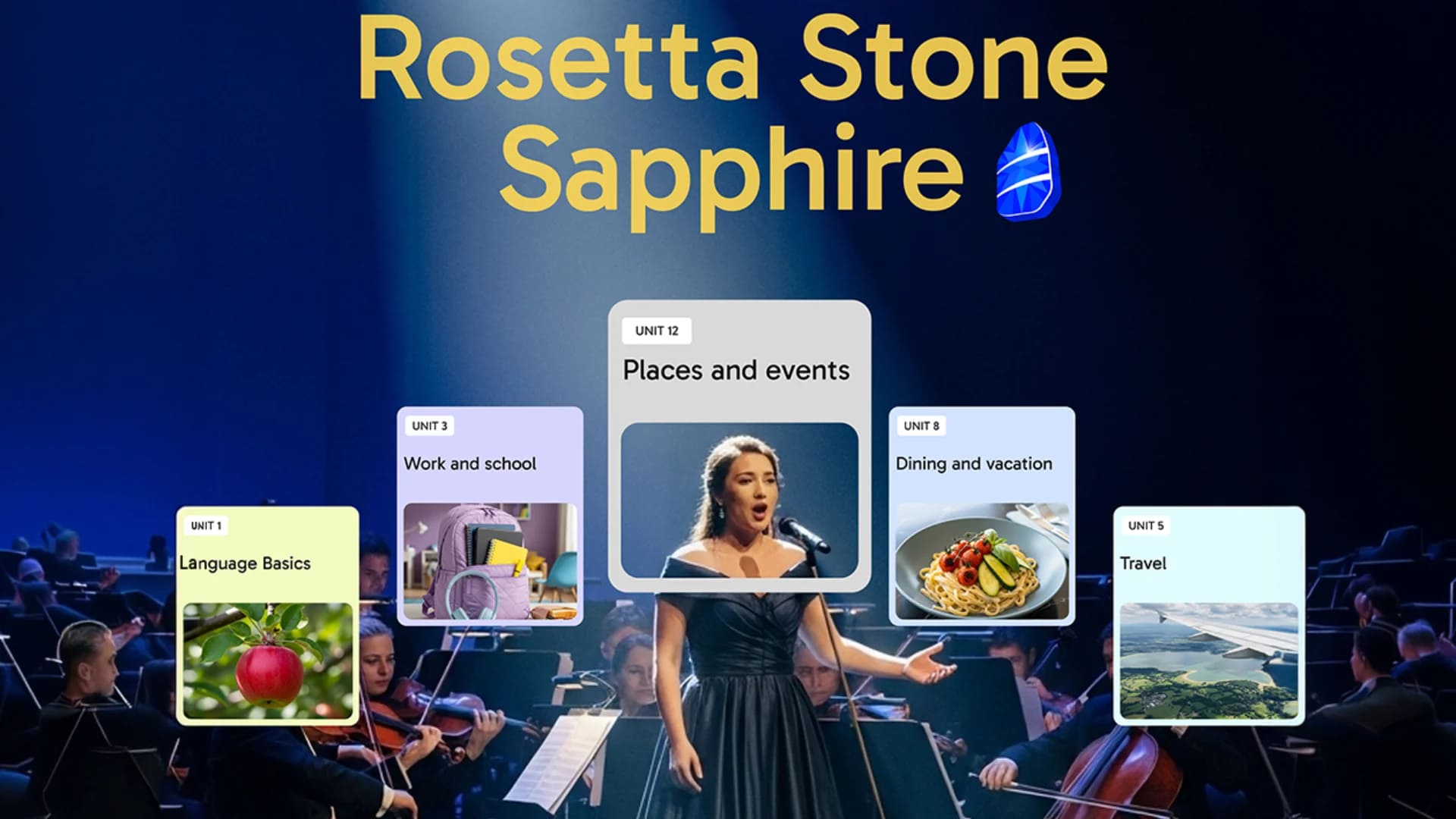
Each language is divided into units, lessons, and activities. Units cover broader subjects such as work, school, home, health, dining, and travel, while individual lessons focus on more specific topics.
Activities can concentrate on speaking, reading, writing, and listening, allowing learners to practice different language skills as they move through the curriculum.
The lessons are designed to be relatively focused and manageable, which can make it easier to fit language practice into a regular routine.
TruAccent Speech Recognition
Speaking and pronunciation are important parts of the Rosetta Stone experience.
The platform’s TruAccent speech-recognition technology evaluates pronunciation and provides feedback while learners practice speaking. It is designed to help users develop more accurate pronunciation instead of simply recognizing vocabulary without saying it aloud.
For learners who want to become more comfortable speaking a language, pronunciation feedback can add another useful part to the learning process.
Chat Missions
Rosetta Stone Sapphire also includes Chat Missions for conversation practice.
These activities are designed around realistic situations, including scenarios that can be relevant to travel and everyday communication. Instead of only studying isolated vocabulary, learners can practice using language in conversational contexts.
This complements the structured lessons by giving learners another way to work with phrases and communication patterns.
Flashcards
Flashcards are another part of the current Sapphire experience.
Rosetta Stone provides more than 500 flashcard sets covering subjects such as travel, sports, animals, art, and other areas. This gives learners an additional way to review vocabulary outside the main lessons.
The flashcard system can be useful for reinforcing words that have already appeared during the structured learning path.
Sapphire Studio
Sapphire Studio adds a more personalized element to the platform.
The feature allows learners to create their own learning materials around topics they are interested in. This can be useful for people who want vocabulary and practice related to a particular hobby, profession, trip, or personal interest.
Rather than relying only on a fixed curriculum, learners can use these tools to focus on subjects that are personally relevant.
Languages Available
Rosetta Stone currently provides access to 25 languages through its unlimited-language offering.
The available languages include Spanish, French, German, Italian, Japanese, Korean, Chinese, Arabic, Dutch, Hindi, Portuguese, Russian, Swedish, Turkish, Vietnamese, Greek, Hebrew, Polish, Persian, Irish, Latin, Filipino, and both American and British English.
Having multiple languages available under the same subscription can be useful for learners who want to study more than one language or change their learning focus over time.
Learning Across Devices
Rosetta Stone supports learning across web and mobile experiences.
The platform allows learners to continue studying across supported devices, while progress can sync between experiences. The Classic mobile app also supports offline learning for applicable content, although certain activities have specific limitations.
This makes the platform suitable for people who want to study at home, during travel, or during short breaks throughout the day.
Rosetta Stone Pricing
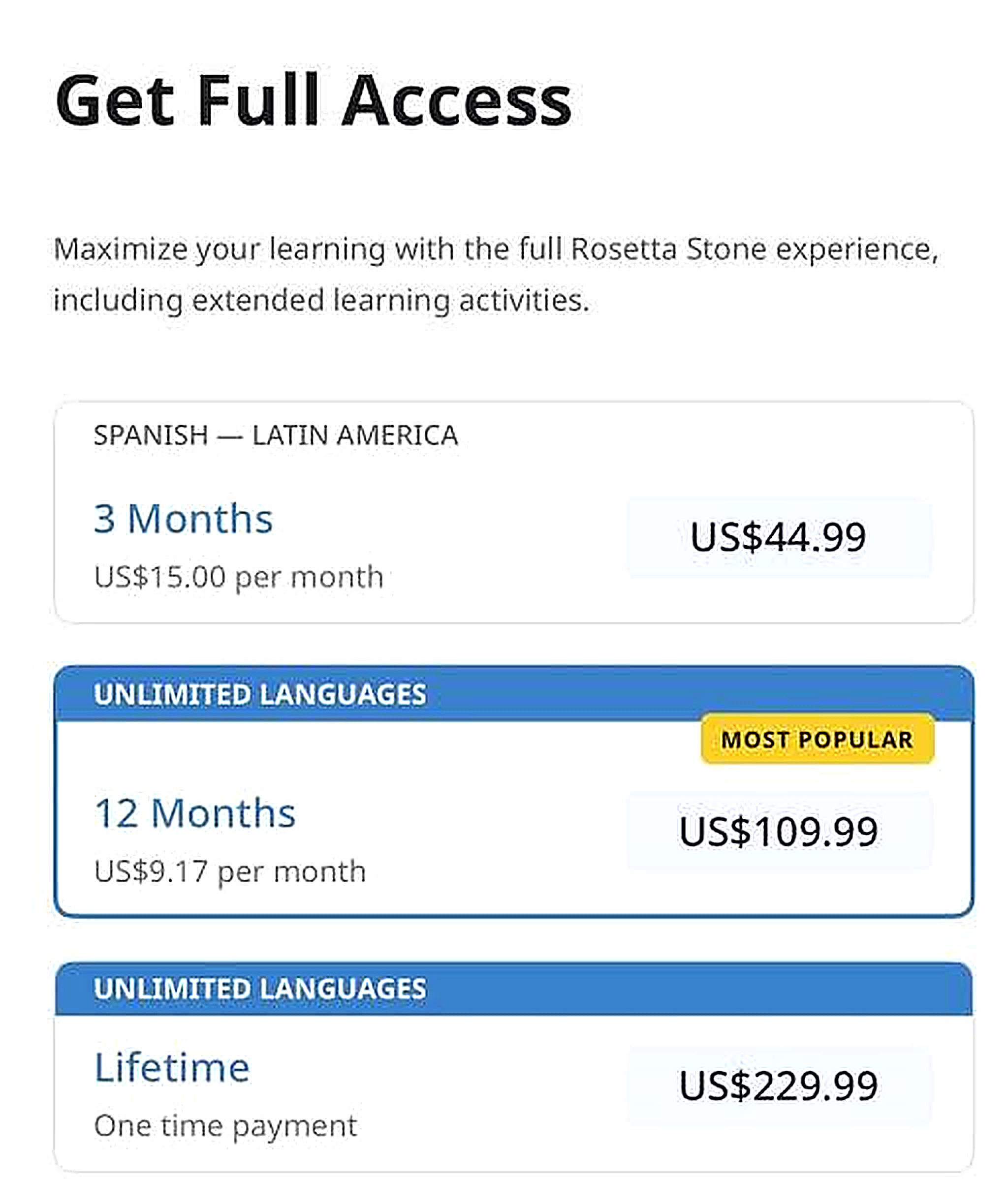
Rosetta Stone offers different subscription options, with pricing varying by region and promotional offer.
Current European pricing shows a monthly option at €19.99 per month and a yearly option at €13.25 per month when billed annually at €159. The current offering includes access to all 25 languages, immersive lessons, TruAccent, Chat Missions, flashcards, and Sapphire Studio.
Rosetta Stone also offers a 14-day money-back guarantee on the referenced subscription offer. Pricing and promotions can change, so the current plan details should be checked before purchasing.
A Lifetime option is also offered in certain circumstances. Rosetta Stone explains that Lifetime access applies for as long as the purchased product and its associated services remain available and supported.
Pros and Cons of Rosetta Stone
Pros
- Immersion-based learning approach
- Dynamic Immersion lessons
- Access to 25 languages with the current unlimited-language offering
- TruAccent pronunciation feedback
- Chat Missions for conversation practice
- More than 500 flashcard sets
- Sapphire Studio for personalized learning materials
- Structured Learning Path
- Reading, writing, speaking, and listening activities
- Web and mobile learning options
- Suitable for individual, school, and business learning environments
Cons
- The immersion approach may feel different from translation-heavy language apps
- Some learners may prefer more direct grammar explanations
- Subscription pricing can be higher than basic language-learning apps
- Certain features vary by product or subscription
- Building conversational ability still requires consistent practice
- The full range of features may be more than a casual learner needs
Who Is Rosetta Stone Best For?
Rosetta Stone can be suitable for learners who prefer an immersive approach and want to develop multiple language skills rather than focusing only on vocabulary memorization.
It may also appeal to travelers, professionals, students, and people learning a language for personal reasons. The combination of structured lessons, pronunciation feedback, conversation practice, flashcards, and personalized learning tools provides several ways to practice.
The platform can also work for people who want to explore multiple languages because the current unlimited-language subscription provides access to all 25 available languages.
Is Rosetta Stone Worth It?

Rosetta Stone offers a distinct approach to language learning centered around immersion rather than constant translation. Its Dynamic Immersion method uses images, sounds, written language, and context to help learners understand their target language directly.
The newer Sapphire experience expands that foundation with Chat Missions, flashcards, Sapphire Studio, and tutoring options alongside the structured Learning Path.
Whether it is worth the subscription depends largely on how a learner prefers to study. Someone looking for an immersion-focused program with a structured curriculum may find the approach suitable, while learners who prefer extensive explanations in their native language may want a different learning style.
Final Verdict
Rosetta Stone remains focused on building practical language skills through an immersion-based learning system. Its Dynamic Immersion method, structured Learning Path, TruAccent pronunciation technology, conversation activities, flashcards, and personalized learning tools give learners several ways to practice.
The current Sapphire experience also provides access to 25 languages, making it possible to explore multiple languages through one subscription.
For learners who want a structured and immersion-focused way to study a new language, Rosetta Stone is worth considering. Its suitability ultimately depends on the learner’s preferred study style, target language, learning goals, and consistency.